
God’s Holy Family as a Sign of Hope to Religious Autocracies
Advent Devotion by Rev. Neal Christie
Matthew 2:13–23
The Christmas story is, at its core, a migration story—then and now. Jesus was born to an occupied people, became a refugee, belonged to a stateless community, fled the Roman state’s genocidal pogrom of infanticide, and lived under the grueling, everyday autocratic threat designed to diminish dignity and humanity among the oppressed. This setting is central to God’s choice to be incarnate among God’s people. God intentionally chooses to experience the world among and alongside marginalized and displaced people.
We live in a season when religious nationalisms of many kinds seek to define who we are, who God is, and what God desires for this pivotal moment in our shared history.
Religious nationalists embolden and mobilize autocrats and share common traits: a providential conviction that God and government are one; a persistent fear that a historically dominant group will be replaced by an “inferior” class, race, or caste of perpetual foreigners; manipulation of legislation to blur, erase and rewrite history to bless the privileged and elevate particular religious groups; deployment of the military and paramilitary on a nation’s own people in the name of a righteous God; cherry-picking scriptures to morally justify exclusion, oppression and violence; propping up patriarchy and misogyny as natural law; the use of lies and propaganda to scapegoat and demonize others; denial of science as contrary to faith; and a monied gospel of prosperity to build wealth for a few on the backs of the impoverished and working poor.
On this road, we remember to weep for the genocidal murder of children whose names we may never hear spoken; we will come to understand the calamitous economic policies that remove with impunity protections for workers—since the 1980s, the top marginal tax rate has fallen from 91% in the 1950s to 28%—and by 2024, the Federal Reserve Bank of St. Louis reported: “The top 10% of households by wealth, with an average of $6.9 million, held 67% of total household wealth, while the bottom 50% of households held only 2.5%.” We will talk about the “One Big Beautiful Bill” that strips immigrants of access to health insurance and nutrition aid, pours massive funding into the expansion of immigration detention, and undermines due process and humanitarian protections. And we will ask where do those ungodly profits go?
As Nicholas Powers found in 2022 for Truthout we will see that a vast network of Christian nationalist organizations funded primarily by “a one percent of megadonors and corporations… some of the richest people and corporations in the world bankroll Christian nationalists, who in turn attack the already limited freedoms of poor people, people of color, women, and LGBTQ people in the name of God.”
The United States is not alone; Hindu nationalism in the world’s largest democracy, India, is grounded in generational casteism falsely claimed to be divinely ordained, and it has devastated the poor, fueled mass attacks on farmers, displaced 60,000 indigenous people and Christian minorities, and stolen land from Muslims and Sikhs. Zionist policies fueling the war in Gaza have inflicted damage estimated at $18.5 billion—seven times Gaza’s 2022 GDP. It will take 350 years for Gaza simply to restore its 2022 level of GDP. Every one of these economic decisions has been blessed by theologies of religious supremacy in the name of the state.
We choose a road with the Holy Family that is sacred but not exceptional or unfamiliar. It is the road to Egypt, but it is also the Exile, the Middle Passage, the Trail of Tears, the Shoah and the Nakba. What other roads will we name out loud? It is also the unexpected road to Galilee and Nazareth with astonishing healings, life transforming parables, and radical community. The way is known to God and pointed to in scripture; we will not be defined by the religious nationalist’s gospel of promised privilege or by the autocrat’s twisted propaganda of a preferred future. We practice welcome and offer welcome; we nurture hope here together, between the river and the sea; and we stop to look for who has been left behind.
As Fr. Richard Rohr says, “When people say piously, “Thy kingdom come” out of one side of their mouth, they need also to say, "My Kingdom go!" The kin-dom of God supersedes and far surpasses all kingdoms of self, personal reward, society, or nation.
This first week of Advent points us in a good direction: we see how religious nationalists worked then and now but even more we can say yes to God’s dream for all of us who choose to walk with Mary, Joseph, and the Christ child: Go out as immigrants, refugees and asylum seekers; find sanctuary on the least expected roads you take; along the way read the signs of every Herod who fear they will be replaced. We open our eyes to the God who in past generations worked acts of liberation and imagine there is a Galilee and Nazareth to walk toward.
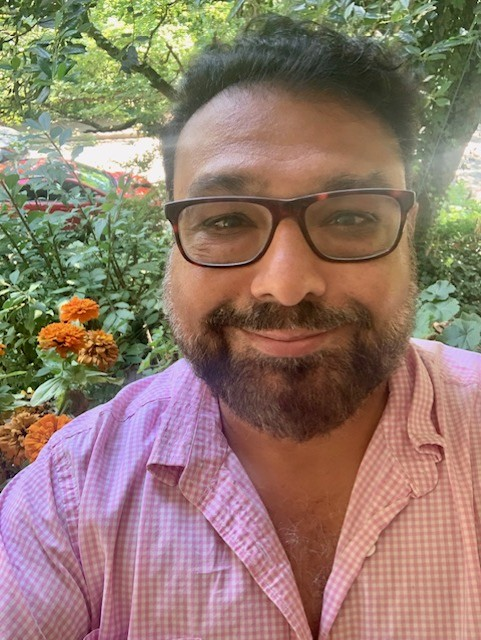
Rev. Neal Christie
cofounded The Religious Nationalisms Project which is a ministry of the New York State Council of Churches and is a consultant for conflict congregational conflict transformation in the Baltimore-Washington Conference. He is a 2025-2026 Civil Society Fellow with the Institute for Islamic, Christian, and Jewish Studies (ICJS). Previously he was Executive Director with FIACONA—the Federation of Indian American Christian Organizations of North America; Executive Minister for Connected Engagement in the Baltimore-Washington Conference; and for twenty-four years Neal served as Assistant General Secretary for Special Projects, Assistant General Secretary for Education and Leadership Formation and Director with the UM Seminar Program on National and International Affairs at the General Board of Church and Society in Washington, DC. He was the lead staff in the world-wide revision of the UM Social Principles (2012-2019) and the revision of the UM Social Creed (2004-2008). Neal serves on the board of the Native American International Caucus (NAIC) and the Central MD Ecumenical Council. He has worked as a trauma hospital chaplain and local pastor. Neal is an ordained elder and full member of the Greater NJ Conference and an affiliate clergy member with the Baltimore-Washington Conference
Neal is the author of "Justice in Everyday Life" published by the Upper Room, "Living as Haves and Have Nots" published by Discipleship Resources, and the introduction and teaching sections to the UMC Social Principles published by Cokesbury.
He attended Yale University Divinity School, Princeton Theological Seminary, The New School for Social Research and took graduate classes at the American University School for International Service and Wesley Theological Seminary.
Neal is married to Lois Clinton, a clinical social worker and they live in Washington, DC where they attend Dumbarton UMC. They are the parents to two young adult children; Calia is a documentary film maker and outreach director with the NY Coalition for the Homeless and Kai is an architectural design student in Washington, D.C.